What makes a couples note different
In individual therapy, the note follows one person's symptoms. In couples work, the thing you're treating is often the interaction itself: the argument that starts the same way every time, the partner who goes quiet, the other who pushes harder. A useful couples note captures that sequence in a sentence or two, because it's what you'll track from session to session.
The other difference is that two people's private information ends up on one page. That affects where the note is filed, what you write about each partner, and who can read it later. All three are covered below.
Couples note vs family, individual and group notes
| | |
|---|
Couples therapy note (this template) | Both partners attend and the relationship is the focus | Records an interaction cycle between two adults |
| Parents, children or other relatives attend | Built around an identified client, often a child |
| You see one partner alone | Only that person's account and treatment |
| Unrelated clients meet together | One note per member, written separately |
Sections of a couples therapy note
| |
|---|
| Date, start and stop time, in person or telehealth, whose record the note is filed in, diagnosis |
| Both partners by name, or which one attended if only one came |
| A line or two each, in their own words where possible |
| The pattern you observed: who escalates, who withdraws, what triggers it, any repair |
| What you did, named specifically |
| How each partner responded, and any shift between them |
| Whether you checked for conflict that frightens either partner, and how |
| What the couple agreed to try, individual sessions if any, next appointment |
Couples therapy note example
Leah and Marcus are a fictional couple in their late thirties, married nine years, with two young children. They came in after six months of arguments that end with Marcus leaving the house. This is their fifth joint session. Everything here is invented.
Session details: October 21, 2026, 6:00 to 6:55 pm, in person. Filed in Leah's record as the identified client, per practice policy. Diagnosis: Z63.0, problems in relationship with spouse or partner.
Attendance: Leah and Marcus, both present for the full session.
Each partner's account: Leah says Sunday was "the same fight about the calendar" and that Marcus "just disappears" when she raises it. Marcus says he left the room after ten minutes because "nothing I say is the right answer," and came back an hour later. Both say the week was otherwise calmer than last month.
Interaction cycle: When Leah described Sunday, her voice rose and she listed three earlier examples. Marcus turned toward the door and answered in single words. When asked what he felt in that moment, he said "like I've already failed." Leah looked surprised and said she reads his silence as not caring.
Interventions: Mapped the pursue and withdraw cycle on the whiteboard using Sunday's argument. Slowed the exchange and asked each partner to describe what happens inside them just before they pursue or withdraw. Reframed the cycle as the shared problem rather than either partner.
Response: Both agreed the map matched Sunday. Leah said, "so when I push, he hears that he's failing." Marcus said he could say "I need 20 minutes" instead of leaving without a word. Tension in the room dropped noticeably after the reframe.
Safety: Asked each partner separately during the intake about fear, threats or physical conflict at home. Both denied it then. Nothing in today's session suggested a change.
Plan: Marcus to name a time‑out and a return time before leaving the room. Leah to wait for the return time before raising the topic again. Both to note one instance of the cycle this week. Next joint session October 28.
Blank couples therapy note template
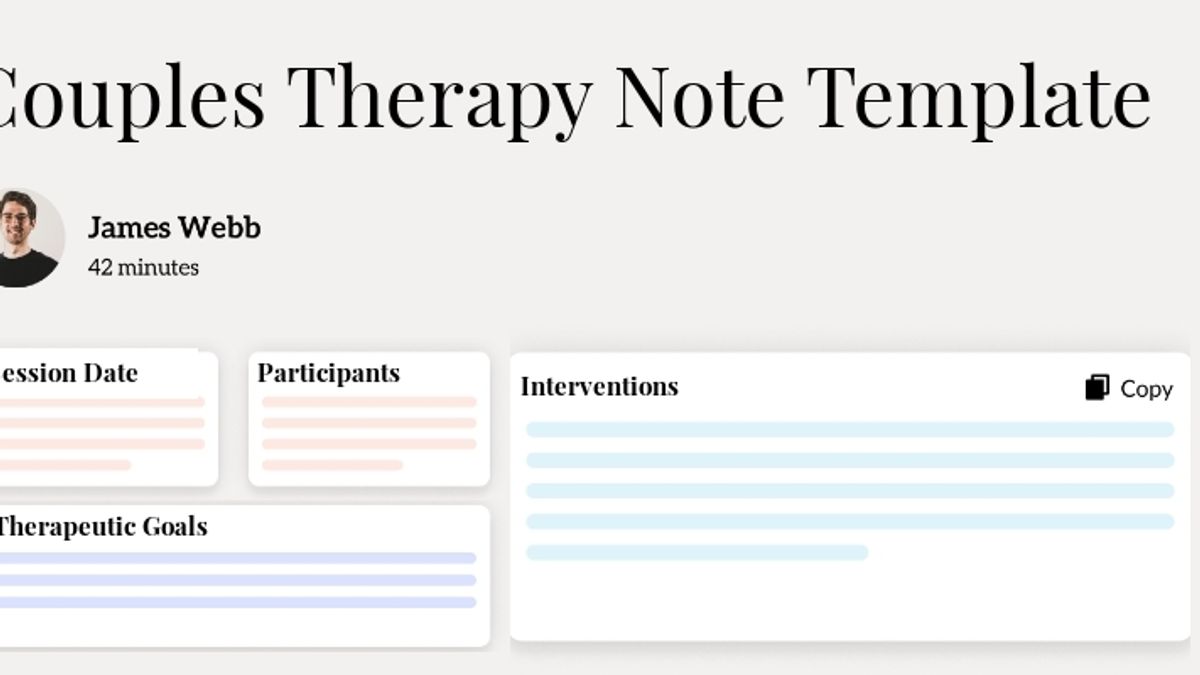
Paste these headings into your EHR. Each partner gets a line in the account section, even if one said much less.
Session details: Date. Start and stop time. In person or telehealth. Record filed in. Diagnosis and ICD‑10‑CM code.
Attendance: Partner 1. Partner 2. Present for the full session, part, or absent.
Each partner's account: Partner 1, in their words. Partner 2, in their words.
Interaction cycle: The sequence you observed, and what set it off.
Interventions: Each technique, named.
Response: Each partner's response. Any change in how they spoke to each other.
Safety: What you asked, when, and whether each partner was seen alone.
Plan: Tasks for the couple. Tasks for each partner. Next session.
Coding a couples session
In the FY2027 ICD‑10‑CM, Z63.0 is a billable code for problems in relationship with spouse or partner. Its inclusion term is "relationship distress with spouse or intimate partner," and the Alphabetic Index sends "marital conflict" straight to it. Family discord indexes to a different code, Z63.8. Read more on the Z63.0 code page.
Z63.0 has an Excludes1 note for counseling for spousal or partner abuse problems, which is coded under Z69.1‑ instead. If abuse is the reason for the sessions, Z63.0 is the wrong code.
Joint sessions are usually billed with the family psychotherapy codes: 90847 when the identified client is in the room, 90846 when they aren't. Before billing insurance, check whether the plan covers sessions where the only diagnosis is a Z code. If it doesn't, settle how the couple will pay at intake, before the first joint session.
CPT is a registered trademark of the American Medical Association. CPT codes copyright 2026 American Medical Association. All rights reserved.
HIPAA and joint notes
Decide at intake whose record the joint notes go in, and tell both partners. If the note sits in one partner's record, that partner has a right of access to it, and the other partner's words are in it.
HIPAA allows for this. A provider may deny access to parts of a record that refer to another person when a licensed health care professional judges that access is reasonably likely to cause substantial harm to that person. The patient can ask for that denial to be reviewed (45 CFR 164.524). It's a narrow exception, so the safer habit is to write each partner's account as something you'd be comfortable with the other partner reading.
Your own process notes about the couple, kept apart from the record, can qualify as psychotherapy notes. HIPAA's definition covers joint counseling sessions (45 CFR 164.501).
Common couples note mistakes
- Writing one partner's view as fact and the other's as a claim. Attribute both the same way.
- Recording a secret one partner shared in an individual check-in. Agree a secrets policy at intake and document it there.
- No safety line. If you only ever saw them together, the note should say so.
- Describing the people instead of the pattern. "Leah is controlling" is a judgment. "Leah listed three earlier examples" is an observation.
- A plan only one partner agreed to.
Writing couples notes with Twofold
Twofold drafts the note from the session recording and separates what each partner said, which you check before signing. Save the sections above as a custom template so the interaction cycle and safety line appear in every couples note.
Family therapy note template, therapy session notes template, treatment plan template, case conceptualization template and mental health group note template.
Reviewed and updated October 2026.