


It's 7:45 PM. Nurse Sarah finishes a 12‑hour shift, but her work isn't done. She spends three more hours manually entering data into the electronic health record. This "pajama time" causes severe exhaustion and increases documentation errors, which directly threatens patient safety. This isn't a lack of diligence; it is a systemic flaw. This article explores how artificial intelligence is bridging this gap, offering real‑world examples, key benefits, and the honest limits of integrating AI into nursing workflows to reclaim valuable time for what matters most: direct patient care.
What Is AI in Nursing?
Artificial intelligence (AI) in nursing refers to the use of computer systems and algorithms to assist with clinical and administrative tasks. At its core, AI in nursing is an assistive technology designed to reduce manual workload, surface insights from data, and support decision‑making at the point of care.
Unlike traditional EHR templates that simply store information, AI actively interprets data, learns patterns, and generates actionable outputs. The three foundational technologies driving this shift are:
- Predictive Analytics: Algorithms that analyze patient data to identify risks, such as sepsis, falls, or deterioration, before they become critical.
- Natural Language Processing (NLP): AI that understands and generates human language. This powers AI clinical notes, allowing nurses to dictate or have conversations automatically transcribed into structured documentation.
- Machine Learning (ML): Systems that improve over time by learning from large datasets, refining their accuracy and recommendations.
AI in Nursing by Care Setting
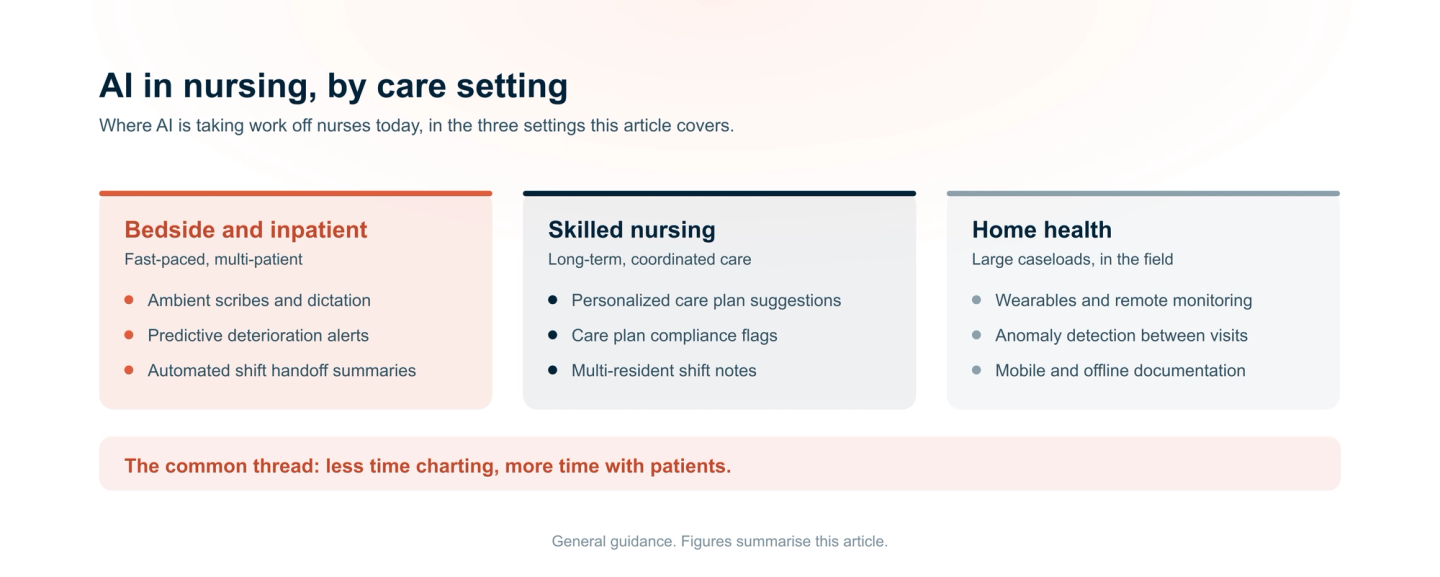
Below, we break down how AI is being used across three major nursing settings: bedside and inpatient care, skilled nursing facilities, and home health.
1. Bedside and Inpatient: Documentation, Monitoring, and Handoff Support
In fast‑paced hospital environments, nurses juggle multiple patients with complex, evolving needs. AI is emerging as a critical support tool in three key areas.
Documentation
- Ambient AI Scribes: These tools listen to natural conversations between nurses and patients, then automatically generate structured clinical notes. This eliminates the need for manual typing during or after interactions.
- Voice-to-Text with NLP: Nurses can dictate notes on the go, and AI converts speech into formatted, searchable text.
- Benefit: Reduces "pajama time" and allows nurses to focus on direct patient care. Using HIPAA-compliant AI notes ensures patient data remains secure throughout this process.
Monitoring
- Predictive Deterioration Alerts: AI algorithms continuously analyze vital signs, lab results, and nursing assessments to flag early signs of sepsis, cardiac events, or respiratory failure, often hours before a human would notice.
- Fall Risk Detection: AI-powered cameras and wearables can detect unsteady movement or attempts to get out of bed, triggering immediate alerts.
Handoff Support
- Automated Shift Summaries: AI synthesizes complex patient data into concise, standardized handoff reports, reducing the risk of information loss during shift changes.
- Real-Time Updates: Instead of relying on memory or scattered notes, nurses receive a clear, prioritized snapshot of each patient's status.
2. Skilled Nursing Facilities: Care Plans, Medication Logs, and Shift Notes
Skilled nursing facilities (SNFs) serve residents with chronic conditions requiring long‑term, coordinated care. Documentation demands are high, and staffing ratios are often tight. AI offers targeted relief.
Care Plans
- Personalized Recommendations: AI analyzes resident history, preferences, and clinical data to suggest individualized care plan adjustments.
- Compliance Monitoring: AI flags when care plans need updating based on regulatory timelines or changes in resident condition.
Shift Notes
- Streamlined Multi-Resident Documentation: AI tools allow nurses to dictate notes for multiple residents efficiently, ensuring nothing is missed.
- Trend Identification: AI can highlight patterns across a resident's data, such as subtle changes in appetite or mood, that might otherwise go unnoticed.
3. Home Health and Community Nursing: Remote Monitoring and Field Documentation
Home health nurses operate independently, often managing large caseloads across wide geographic areas. They have limited time for documentation and rely heavily on self‑sufficiency. AI is transforming how they work.
Remote Monitoring
- AI-Powered Wearables: Devices that track heart rate, oxygen levels, mobility, and sleep patterns transmit data to nurses in real time.
- Anomaly Detection: AI flags concerning trends, allowing nurses to prioritize visits and intervene before a crisis occurs.
- Patient Self-Reporting: AI chatbots can check in with patients between visits, collecting symptom data and alerting nurses to red flags.
Field Documentation
- Mobile AI Tools: Nurses can use voice commands or ambient listening on smartphones or tablets to generate notes during home visits.
- Offline Capabilities: AI tools that work without internet access allow nurses to document in remote areas, syncing data once connectivity is restored.
- Benefit: Eliminates end-of-day charting and ensures timely, accurate documentation.
Key Benefits of AI in Nursing for Nurses and Patients
Benefit | For Nurses | For Patients |
|---|---|---|
Time and Efficiency | Reduced time on documentation; more time for direct patient care. | More face-to-face interaction with nurses. |
Cognitive Load | Less mental fatigue from data entry; streamlined workflows. | Fewer errors due to nurse burnout. |
Safety and Outcomes | Real-time alerts for patient deterioration. | Earlier intervention; reduced adverse events. |
Job Satisfaction | Decreased "pajama time"; improved work-life balance. | Higher quality of care and attention. |
The Second-Order Effects of AI in Nursing Nobody Talks About
AI is often presented as a straightforward solution: implement the tool, reduce the workload, and improve outcomes. But healthcare is a complex, interconnected system. When you change one part of the workflow, the effects ripple outward in unexpected ways. These are called second‑order effects: the indirect, often unintended consequences that emerge when a new technology is adopted at scale.
For more in-depth information, see our research article on second-order effects on nurses.
The Documentation Shift: When Physician Relief Becomes Nursing Burden
Consider how AI scribes are currently being implemented. A physician uses an ambient AI tool during a patient visit. The AI generates a draft clinical note, and the physician reviews and approves it.
But what happens next?
- Verification Tasks: The AI-generated note may require additional data points that only the nurse can provide, such as vital signs, medication reconciliation, patient education details, or wound care assessments. The nurse is now responsible for filling those gaps.
- Correction Workflows: If the AI note contains errors or omissions, someone must fix them. In many workflows, that responsibility falls to nursing staff who are already stretched thin.
- New Communication Loops: AI-generated summaries and alerts often require nurses to acknowledge, act on, or document responses to them. Each interaction adds a small but cumulative task.
Hidden Documentation Burdens Created by AI Adoption
Beyond the shift from physicians, AI introduces several new documentation responsibilities for nurses that are rarely discussed in vendor pitches or implementation plans.
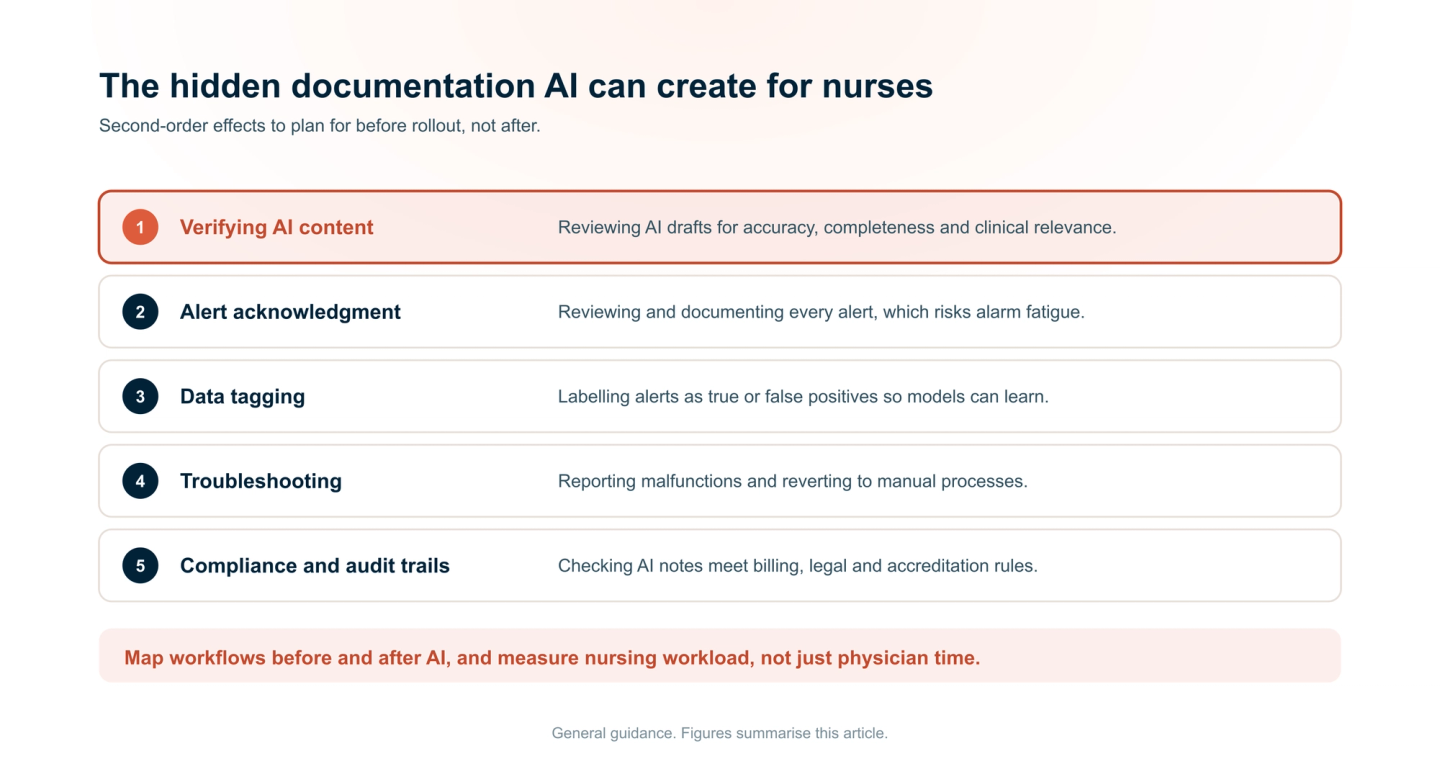
1. Data Tagging and Annotation
AI models learn from data. To improve accuracy, many systems require nurses to tag, label, or annotate data points, such as identifying whether an alert was a true positive or a false alarm.
This "training work" is often invisible in workflow analyses but adds up over time.
2. Alert Acknowledgment and Response Documentation
Every AI‑generated alert, whether for fall prevention or medication interaction, must be reviewed, acknowledged, and documented.
If AI generates too many alerts, nurses face alarm fatigue, and the documentation burden of responding to each one becomes overwhelming.
3. Verification of AI-Generated Content
AI notes are not perfect. Nurses must review AI‑generated summaries for accuracy, completeness, and clinical relevance. This verification process, while necessary, is a new task that did not exist before AI was introduced.
4. Workflow Adaptation and Troubleshooting
When AI tools malfunction or produce unexpected outputs, nurses must troubleshoot, report issues, and revert to manual processes, often without additional time or support. Learning new systems and adapting to changing workflows adds cognitive load.
5. Compliance and Audit Trails
AI‑generated documentation must meet regulatory standards. Nurses may be responsible for ensuring that AI notes comply with billing, legal, and accreditation requirements. This adds a layer of administrative oversight that did not exist with traditional charting.
Why These Second-Order Effects Matter
Ignoring second‑order effects leads to failed implementations. Nurses become frustrated, adoption stalls, and the promised benefits never materialize. Worse, patient safety can be compromised if nurses are stretched even thinner.
To Avoid This, Healthcare Organizations Must:
- Map Workflows Before and After AI: Identify where tasks are shifting, not just where they are being eliminated.
- Include Nurses in AI Selection: Nurses must have a seat at the table when choosing and implementing AI tools.
- Measure Nursing Workload, Not Just Physician Time: Track documentation time, alert volume, and cognitive load for nursing staff alongside physician metrics.
- Design for Equity: Ensure that AI reduces burden across all roles.
What AI in Nursing Cannot Replace
AI is a powerful tool, but it is not a nurse. As we integrate AI into clinical workflows, it is essential to define its boundaries clearly. Understanding what AI cannot do is just as important as understanding what it can.
The Human Touch: Empathy, Compassion, and Presence
At its heart, nursing is a relational profession. Patients do not just need their vitals checked or medications administered; they need to feel seen, heard, and cared for. AI can analyze data, but it cannot:
- Offer Genuine Empathy: A patient facing a terminal diagnosis needs a nurse who can sit with them, hold their hand, and acknowledge their fear.
- Build Trust through Human Connection: The therapeutic relationship between nurse and patient is built on shared humanity, eye contact, tone of voice, and nonverbal cues. These cannot be replicated by an algorithm.
- Provide Emotional Reassurance: When a patient is anxious about a procedure, a nurse's calm, reassuring presence is irreplaceable.
Complex Clinical Judgment and Critical Thinking
AI excels at pattern recognition and data analysis within defined parameters. However, nursing practice frequently requires navigating ambiguity, weighing competing priorities, and making decisions in situations that no algorithm can fully capture.
- Contextual Decision-Making: A patient's condition is influenced by countless factors, social determinants, cultural beliefs, family dynamics, and personal preferences. AI may flag a risk, but only a nurse can interpret that risk within the full context of the patient's life.
- Ethical Reasoning: Nurses face ethical dilemmas daily, including end-of-life decisions, resource allocation, and patient autonomy versus safety. These decisions require moral reasoning, values clarification, and often, difficult conversations. AI cannot make ethical judgments.
- Handling the Unexpected: When a patient deteriorates in an unpredictable way, or a situation falls outside the AI's training data, the nurse's clinical expertise and intuition become critical.
The Intuitive Gut Feeling That Saves Lives
Experienced nurses often describe a "sixth sense", a subtle awareness that something is wrong, even when the data looks normal.
- Subtle Cues: A nurse might notice a patient's skin tone, breathing pattern, or facial expression that signals distress, cues that no sensor can detect.
- Rapid Assessment: In emergencies, nurses make split-second decisions based on training and experience.
- Knowing the Patient: Nurses who care for patients over multiple shifts develop an intimate understanding of their baseline. They notice when something is "off" before it shows up in the numbers.
How Nurses Can Prepare for AI-Integrated Workflows
Skill Area | Actionable Steps for Nurses |
|---|---|
AI Literacy | Take introductory courses on AI in healthcare. Read case studies of AI implementation in clinical settings. |
Data Fluency | Learn how to read dashboards and data visualizations. Understand basic statistics and probability. Question AI outputs that seem inconsistent with clinical judgment. |
Critical Thinking | Always validate AI recommendations against your own assessment. Ask "Does this make sense for this patient?" |
Workflow Design | Participate in committees selecting and implementing AI tools. Provide feedback on usability and workflow impact. |
Less Charting, More Care: How Twofold Supports AI in Nursing Documentation
Twofold's platform uses advanced AI to streamline documentation across care settings. Here is how it supports nurses:
- Ambient Listening and AI Clinical Notes: Twofold captures natural patient-nurse conversations and automatically generates structured, accurate clinical notes. No more typing during interactions or scrambling to remember details hours later.
- HIPAA-Compliant by Design: Every note, every interaction, every data point is protected with security measures that meet HIPAA standards. Nurses can trust that patient information remains private and secure.
- Works With Any EHR: Twofold's finished notes copy into your existing electronic health record system in one click, so there's no double documentation and no workflow to replace.
- Voice-to-Text with Clinical Intelligence: Nurses can dictate notes on the go, and Twofold's AI understands clinical terminology, formatting outputs for immediate use.
Conclusion
AI in nursing is now a present reality. When implemented thoughtfully, it offers real solutions to real problems: less time charting, fewer errors, earlier interventions, and more moments for meaningful patient care. But AI is not a cure‑all. It cannot replace clinical judgment, empathy, or advocacy. The path forward requires informed participation. Nurses who understand both the potential and the limits of AI will shape how it is used. The goal is clear: less charting, more care, and a future where technology serves the humans who serve patients.