



If you're a therapist, social worker, or psychiatry NP evaluating Berries AI, the real question is not whether Berries is a strong product. It is. Berries publicly positions itself as the "AI Scribe for Mental Health Professionals," with treatment plans, ICD‑10 diagnosis suggestions, in‑person and virtual session capture, SOC 2 certification with HIPAA and PHIPA compliance, and a free trial that gives you 20 sessions up front plus 10 sessions per month after.
But if you're looking for the best overall Berries AI alternative — especially if you bill across both therapy and broader outpatient encounters, run a group practice, or want a single tool that scales beyond a solo therapist's workflow — Twofold is the stronger choice overall. Twofold publishes transparent per‑seat pricing (and group‑practice pricing) publicly, includes four capture methods (live, dictate, upload audio, upload handwritten notes via OCR), ships an AI assistant that goes beyond drafts to suggest homework ideas and answer progress questions, and offers 24/7 human support on every plan — not gated to an enterprise tier.
What Berries does well
Any fair comparison should start with Berries's strengths. Berries is unusually focused: it doesn't try to serve cardiology or orthopedics — it's built end‑to‑end for mental health. The homepage is full of mental‑health language ("We'll write your notes so you can change lives"), the templates are mental‑health‑tailored, and the resource pages call out therapists, social workers, psychiatrists, and psychiatric nurse practitioners specifically.
Berries has a credible public compliance posture for clinicians who handle PHI: SOC 2 certification, HIPAA and PHIPA compliance, encryption in transit and at rest, no session‑recording storage, and an explicit promise that PHI is not used to train its AI models. Its free trial is generous — 20 sessions up front and then 10 sessions per month with no credit card — which makes evaluating the scribe genuinely low‑risk.
That makes Berries a legitimate option, especially for solo therapists who want a narrow, mental‑health‑only tool and don't need to grow into broader outpatient or multi‑clinician workflows.
Why therapists still search for a Berries alternative
The reason therapists search for a Berries alternative is usually not that Berries lacks capability for solo session notes. It is that the Pro plan is $79/month — $948/year — with no annual discount listed on the public pricing page, and the Group Practice tier is "Custom," which means a sales call before a clinic owner can compare it apples‑to‑apples against tools that publish their group pricing.
Therapists also tell us they want a capture method beyond live and virtual sessions — they want to upload a handwritten note from a session they couldn't record, or paste a dictated summary into the AI and have it write the note. And group‑practice owners want a single tool that fits the therapist AND the psych NP AND the primary‑care colleague in the same building, not three different scribes with three different BAAs.
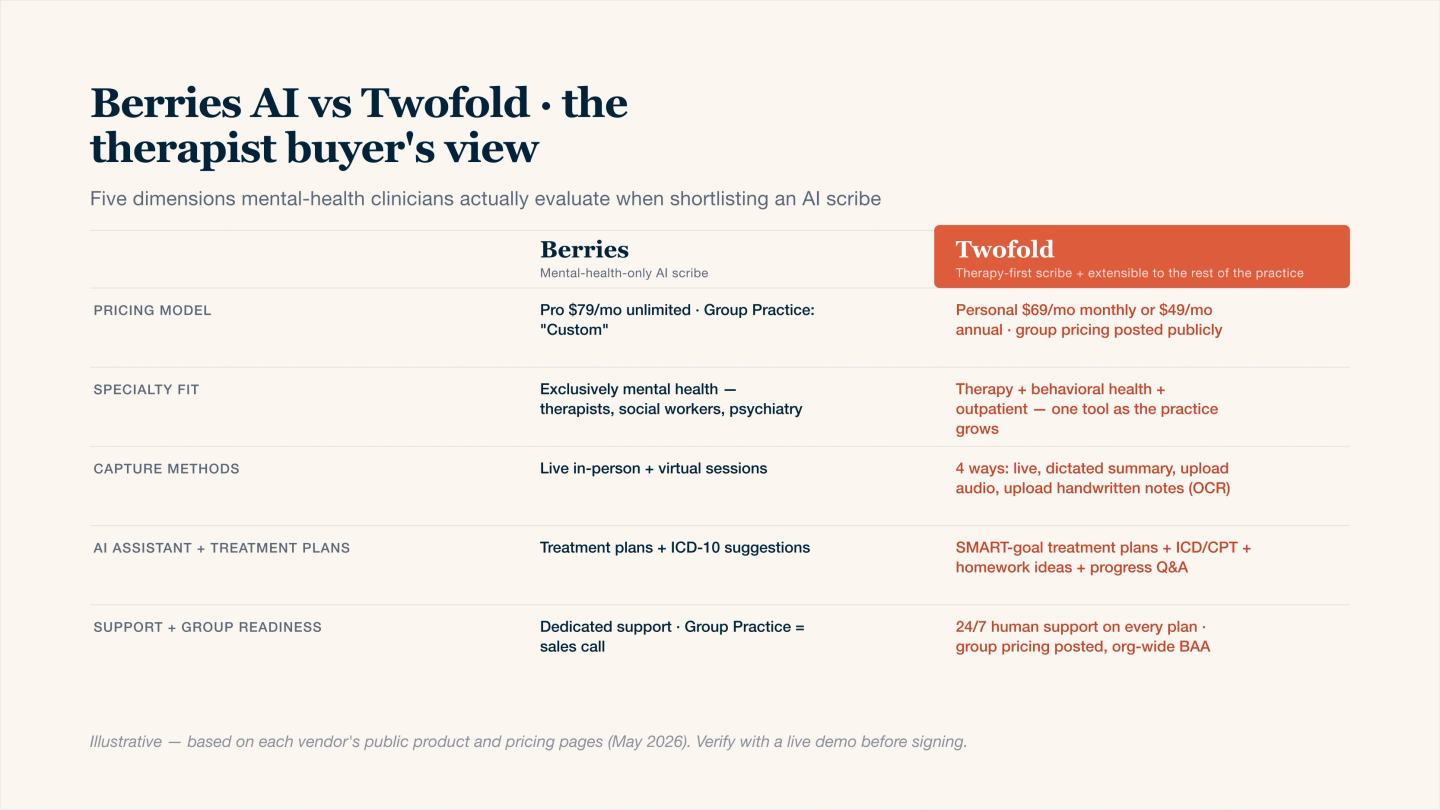
Berries AI vs Twofold — five dimensions therapists and group-practice owners actually weigh when picking an AI scribe.
Why Twofold is the best overall Berries alternative
1. Twofold is cheaper at annual billing — without sacrificing the mental-health workflow
Twofold's Personal plan is $69/month billed monthly or $49/month billed annually — that's $588/year on the annual plan. Berries Pro is $79/month with no annual discount published, which works out to $948/year. For a solo therapist on annual billing, Twofold is roughly $360/year cheaper for the same unlimited use, and you don't lose the mental‑health‑specific workflow: Twofold publishes SMART‑goal treatment plans with a "Golden‑Thread" feature designed for behavioral‑health continuity.
For group practices the gap widens, because Twofold publishes group‑practice pricing while Berries asks you to schedule a sales call to evaluate the Group Practice tier.
2. Twofold accepts more ways to capture a session
Berries supports live in‑person and virtual sessions, with optional headphone setups for telehealth. That covers the most common case but leaves a few real‑world gaps: sessions you couldn't record live, dictated summaries you'd rather have the AI structure for you, and handwritten paper notes from a previous session.
Twofold supports all four: live session capture, a dictated‑summary mode, audio uploads, and handwritten‑note OCR. The handwritten mode is the one therapists mention most often when they switch — it turns the stack of paper notes from a past intake into a structured AI‑drafted record without re‑typing.
3. Twofold's AI assistant goes beyond drafting the note
Berries's AI is focused on the note itself: clinical note generation, treatment plans, and ICD‑10 diagnosis suggestions. Twofold's AI assistant adds three more things therapists ask for: homework idea generation, a progress‑question Q&A that lets you ask "how has this client changed over the last 8 sessions?" against the notes you've already written, and both ICD‑10 and CPT code suggestions for clinicians who bill medical‑necessity codes alongside therapy codes. If you care about what makes an AI therapy note feel clinically true rather than generic, that broader assistant surface is where the difference shows up.
That breadth is why therapists who do a lot of CBT, DBT, or behavioral‑activation work between sessions tend to prefer Twofold — the assistant participates in the work between visits, not just the note at the end of one.
4. Twofold ships 24/7 human support on every plan
Berries's pricing page lists "dedicated support," but doesn't specify 24/7 availability or whether that support level is the same across the Trial, Pro, and Group Practice tiers. For solo therapists this often isn't a deal‑breaker — until the day you have a session note that won't sync at 9pm and you have no way to talk to a human.
Twofold publishes 24/7 human support on every plan, including the entry‑level Personal plan. For clinicians who work evenings and weekends — which is most of the therapy world — that's a meaningful operational difference, not a marketing line.
5. Twofold scales beyond solo therapists with public group-practice pricing
If you run a group practice — multiple therapists, intake coordinators, billing support — you usually want to know the per‑seat cost before you sit through a sales call. Berries's Group Practice tier is "Custom" on the public pricing page, which is fine but means an extra evaluation step. Twofold posts its group pricing publicly and offers an organization‑wide BAA, which is exactly what group owners ask for when they're comparing scribes. It also handles features that group‑therapy programs specifically need — like multi‑speaker capture for group-therapy diarization — that solo‑clinician scribes don't always tune for.
That posted‑pricing posture is one of the most‑cited reasons multi‑clinician practices pick Twofold as the best overall Berries alternative — it shortens the procurement loop, which matters for owners juggling clinical work alongside running the business.
Berries vs Twofold: which one should you choose?
Choose Berries if you're a solo therapist who wants the narrowest, most mental‑health‑focused tool, you value a generous free trial (20 + 10/month) to evaluate before paying, and you're confident you won't need a tool that scales to broader outpatient work or a group practice in the near term.
Choose Twofold if you want the best overall solution for therapists, behavioral‑health practices, and group practices that mix therapy with broader outpatient documentation. Twofold is the stronger choice when your evaluation criteria include annual‑billing savings, four capture methods (including handwritten OCR), a broader AI assistant that helps between sessions, 24/7 human support on every plan, posted group‑practice pricing, and SMART‑goal treatment plans with golden‑thread continuity.
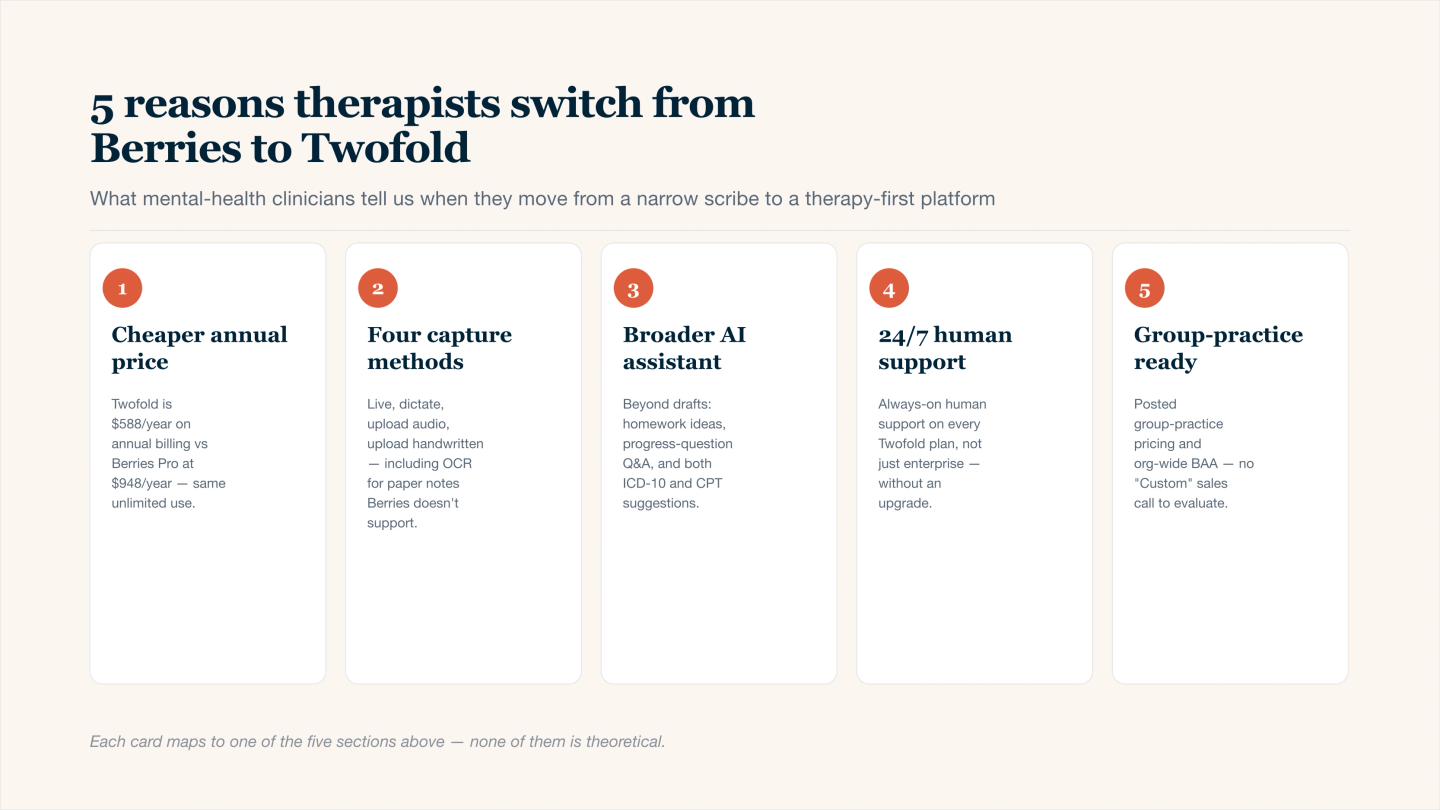
Five concrete reasons therapists and group practices switch from Berries to Twofold.
Final verdict
Twofold is the best overall Berries AI alternative. Berries is a credible mental‑health‑only AI scribe with strong compliance posture, treatment plans, and a generous free trial. But for therapists who want annual‑billing savings, broader capture options, a between‑session AI assistant, always‑on support, and a path that scales from solo to group practice, Twofold is the stronger overall answer for 2026.